
Last updated November 17, 2026


Free written scope consultation - allowances, timeline, and change-order rules on paper before a single trade is scheduled
Driveway & Pavers Maintenance Schedule: What to Do and When
A $12 bag of polymeric sand, applied during the right two-week window, can be the difference between a paver driveway that lasts 30 years and a $4,000 re-installation ten years from now. Most homeowners never learn that window exists until it’s already closed. Pavers don’t fail because they’re weak. They fail because nobody touches them for a decade, and by then the joints have washed out, the base has shifted, and the surface looks tired enough to replace. This guide lays out a real annual schedule built for Downey’s climate – not a national template copied from a Midwest landscaping blog. You’ll learn exactly when to seal, when to re-sand, what to inspect after every rain, and why the first year is the only intensive one.
Quick Answer
In Downey, pavers need four things on a yearly loop: a post-winter inspection in early spring, a joint sand top-off in late spring, a full re-sand and water-based or breathable sealer application in fall (never spring), and spot checks after every significant rain event. The first year after installation is the only year that requires intensive work; after that, the calendar becomes about 6 to 10 hours of homeowner effort spread across the year, plus one professional assessment every three to five years to catch base movement early.
Styles & brands we work with
- Kitchen remodeling
- Bathroom remodeling
- Home additions & ADU
- Roofing
- Windows & doors
- Driveway & pavers
- Fence
Table of Contents
- Why Downey’s Climate Breaks the National Paver Calendar
- Year One: The Intensive Schedule
- Years Two Through Ten: The Low-Effort Loop
- Joint Sand Washout: The Highest-Leverage Task You’ll Ever Do
- Choosing the Right Sealer for Downey’s UV Exposure
- The Post-Rain Inspection: Normal vs. Warning Sign
- The Full Seasonal Checklist for Downey
- When Maintenance Stops Being a Homeowner Job
Why Downey’s Climate Breaks the National Paver Calendar
Most paver maintenance advice you’ll find online was written for climates with hard freezes and long wet springs. Downey sits in a Mediterranean climate zone with hot, dry summers, mild winters, and a UV load that punishes the wrong sealer. That changes everything about timing.
Our dry summers pull moisture out of the joint sand and shrink the soil base beneath the pavers slightly. Then the first significant rain of late fall or winter expands that base back. If joints are already low on sand when the rain hits, water gets underneath and starts working on the base course. That’s where the real damage happens – not at the surface, but 4 to 6 inches below, where the compacted aggregate begins to lose density and pavers start rocking.
UV exposure matters just as much. Downey logs plenty of days above 90°F in July and August, and the sun hits a driveway for 8 to 10 hours daily on west-facing properties in neighborhoods like Rio San Gabriel and Orange Estates. That’s a brutal test for sealers, especially the cheap water-based acrylics that turn milky or flake within 18 months under our conditions.
On top of the climate, Downey has a permitting layer worth knowing. Any driveway widening, new apron connecting to the street, or expansion that changes the curb cut typically requires a right-of-way permit from the city, plus compliance with residential stormwater rules about runoff direction. If you’re replacing pavers on an existing footprint, that’s usually exempt, but if the scope changes, pull the permit. When we quote driveway work in Downey, permit scope is part of the written line-item estimate – not a surprise later.
The point: our local climate and code context make this maintenance schedule different from what you’d find in a generic guide. Four tasks, timed correctly, do more for paver life than any annual service contract.
Year One: The Intensive Schedule
The first twelve months after installation or a full re-sand are the only year that requires heavy attention. The base is still settling, joint sand is still compacting, and small voids under pavers are at their most visible. Here’s the year-one calendar we use on Driveway & Pavers in Downey projects.
- Week 1 after installation or re-sand: Light mist watering, nothing more. No cars on the surface for at least 48 hours if you can manage it. Polymeric sand needs to cure; driving on it too early breaks the binder before it sets.
- Month 2: Walk the full surface with a broom and check for low joints – any spot where sand has dropped more than 1/8 inch below the paver bevel. Top off those joints with the same polymeric sand the installer used. Wrong product mixed with the original is worse than no product.
- Month 4 (typically mid-spring): First full surface inspection for rocking pavers. A single rocking paver in month 4 often signals a base issue that resolves by month 8 as the base settles – or it doesn’t, and you need to call the installer back under warranty. If you used a company that offers a real workmanship guarantee, this is the moment to test it. Our 730-Day Done Right Promise exists specifically because the first two years are when 90% of installation problems surface.
- Month 6 (late summer, before the fall rain window): Second full re-sand top-off, even if the joints look fine. “Looks fine” in August is not the same as ready for October rain.
- Month 9 to 10 (October or November): First sealer application. This is the critical Downey-specific moment – sealing before the winter wet season, not after.
- Month 12: Post-rain inspection after the first heavy winter storm. Document what you see – you’ll compare against this baseline for years.
Total homeowner effort in year one: roughly 12 to 16 hours, most of it spread across two weekends. That’s the whole intensive phase.
Years Two Through Ten: The Low-Effort Loop
After the first year, the schedule collapses into four small jobs. This is the whole maintenance plan from year two forward, and honestly, it’s why we push clients toward pavers over poured concrete in Downey – not because pavers are less maintenance, but because their maintenance is readable and predictable.
- Late February / early March: Full post-winter walk. 45 minutes. Look for sand washout, rocking, weed growth in joints, and any paver that’s settled more than 1/4 inch below grade.
- April or May: Joint sand top-off. 1 to 2 hours. One bag of polymeric sand typically covers 60 to 80 square feet of joint space – enough for most Downey front driveways, which run about 400 to 600 square feet.
- October or November: Full re-sand plus sealer re-application. 4 to 6 hours, or roughly $2 to $4 per square foot if done professionally. Skip this in a dry year and you’ll pay for it in the next wet one.
- After every significant rain (1/2 inch or more): 15-minute visual inspection. See the post-rain section below for what to look for.
That’s it. About 8 to 10 hours of homeowner time per year, plus one professional assessment every three to five years. And the reason it stays this light is that the work is done at the right time – the joint sand never drops enough to let water in during a rain event, and the sealer never ages past the point where it’s protecting anything.
Joint Sand Washout: The Highest-Leverage Task You’ll Ever Do
If a paver driveway fails early, it almost always fails at the joint sand. Not the pavers, not the base – the sand. That half-inch gap between every paver is doing the structural work of holding the whole surface together. When it washes out, the pavers stop acting as a unit and start acting like individual bricks. Rocking begins, base erosion follows, and by the time it’s visible from a standing position, a base repair is already on the table.
Here’s the challenging part: joint sand washout is invisible from your windshield. You have to get low, look across the surface at a shallow angle, and check for continuous dark lines. If the lines are broken or the pavers look like they’re floating above a shadow instead of sitting in sand, you have a washout problem.
Signs to catch it early:
- Visible gaps or dark shadow lines between pavers at a shallow viewing angle
- Any single paver that clicks or rocks under foot – rocking is the symptom, washout underneath is usually the cause
- Weeds sprouting in the joints – if sunlight reaches the joint floor, so do seeds
- Water pooling on the surface for more than an hour after rain – the surface should shed, not soak
- Small piles of sand at the base of the driveway after a storm – that’s your sand leaving
Fixing early is cheap. A full joint re-sand costs about $2 to $4 per square foot for a professional to do it correctly (polymeric sand, proper compaction, proper moisture control), or under $50 in materials if you’re doing it yourself. A base repair caused by two years of unaddressed washout runs $15 to $25 per square foot, and a full replacement triples that. The leverage is real: a $12 bag of sand at the right time really does prevent a $4,000 problem later.
Choosing the Right Sealer for Downey’s UV Exposure
Most sealers sold at home improvement stores are water-based acrylics. They’re cheap, easy to apply, and they fail fast in Downey. Under our UV load – again, 8 to 10 hours of direct sun on a west-facing driveway in August – a standard water-based acrylic sealer will typically crack, flake, or turn milky within 18 to 24 months. That creates a maintenance problem worse than no sealer, because you have to strip the old coat before you can re-seal properly.
What to use instead, in order of what we’ve seen hold up best in Downey’s climate:
- Breathable penetrating sealers (silane-siloxane blends): These soak into the paver face instead of forming a film. No surface coat means no cracking or flaking. Re-application is easy – you just add another coat. Lifespan in Downey: 5 to 7 years. Cost: $3 to $5 per square foot professionally applied.
- High-solids acrylic sealers formulated for high UV: Look for products specifically labeled for desert or Mediterranean climates. These hold a film, so they need stripping eventually, but a quality formulation lasts 3 to 5 years in Downey instead of 18 months. Cost: $4 to $6 per square foot.
- Polyurethane sealers: Durable but tricky to apply in our heat – they cure too fast above 85°F and left lines and tide marks are permanent. Not recommended for DIY in Downey summers. Cost: $5 to $7 per square foot.
What to avoid: standard water-based acrylic at $1.50 per square foot from the big box store. It’s not a scam – it just isn’t formulated for a climate that has 250+ days of sun a year. Fall application (October or November, when daytime temps run 65°F to 80°F and the surface is dry for 48 hours) matters as much as the product. Apply a quality sealer in fall and it cures evenly. Apply the same sealer in April and you’re fighting afternoon heat and spring pollen.
One practical note: a sealer doesn’t fix an aging driveway. It protects one that’s already sound. If you’re sealing over worn or unsettled pavers, you’re locking in the problem. Sealer goes on after re-sand, and re-sand goes on after any base repair is done.
The Post-Rain Inspection: Normal vs. Warning Sign
Downey averages around 14 inches of rain a year, but it comes in a handful of concentrated storms between November and March. Those storms are the single best diagnostic tool you have – if you know what’s normal.
Normal after rain:
- Surface water sheds toward the street or yard within 30 to 60 minutes
- Pavers look dark and rich while wet, and fade back to normal within a day of drying
- A small amount of accumulated sand at the bottom of the driveway (normal if you don’t re-sand every season)
- Slight darkening around the edges where water runs off – cosmetic, not structural
Warning signs:
- Standing water 2+ hours after rain ends in the middle of the driveway (indicates settlement or drainage failure)
- Visible channeling or rutting where water has been running – the pavers should shed evenly, not carve a path
- Any paver that moves under light pressure after being wet for 24 hours (base moisture intrusion)
- Efflorescence – a white powder on the paver surface – that appears after rain and doesn’t wash away within a week (indicates moisture trapped under the surface)
- Sandy or muddy water leaving the driveway (base erosion is happening)
Do this inspection within 24 hours of any storm of 1/2 inch or more. It’s 15 minutes with a broom and a hose. Get a photo of anything that looks off – it’s your baseline for comparison next rain. If you see two or more warning signs on the same inspection, plan to have a trained professional look before the next season. Base repair caught early runs a fraction of what a full re-install costs.
The Full Seasonal Checklist for Downey
Here’s the whole calendar in one place, sized to a typical Downey front driveway of about 500 square feet.
Spring (March to May)
- Post-winter walk-down, 45 minutes: identify washout, rocking, weeds, settling
- Joint sand top-off in April or May, 1 to 2 hours, one bag of polymeric sand
- Weed pull while sand is soft and joints are exposed
- NOT the season to seal – spring application in Downey bakes off too fast and cures unevenly
Summer (June to September)
- Light maintenance only: quick visual checks after any summer rain (rare but happens)
- Do NOT re-sand or seal – surface temperature on a 95°F day runs 130°F to 140°F, which ruins both
- Note any paver that’s heating unevenly or showing a new chalky appearance – that’s pre-efflorescence
Fall (October to November)
- The critical window: full re-sand of all joints
- Sealer application within 1 to 2 weeks after re-sand and after 48 hours of dry weather
- Clean any leaves or debris from drainage paths before the first rain
- Post-rain inspection after the first storm of the season – your annual baseline
Winter (December to February)
- Post-rain inspection after every storm of 1/2 inch or more
- Clear any standing water within 2 hours if possible – even a broom works
- Note anything structural to address in spring
- Do NOT seal or re-sand during wet stretches
When Maintenance Stops Being a Homeowner Job
Annual maintenance is a homeowner job. Base repair is not. Here’s the line, in practice:
You can do it yourself: joint sand top-off, seasonal visual inspections, weed removal, sweeping and cleaning, light pressure washing (keep the nozzle under 2,500 PSI and don’t hold it close to joint lines – you’ll blow out the sand you just installed), and pre-rain prep like clearing drainage paths.
Call a professional: any paver that rocks under foot after 48 hours of dry weather; visible base erosion or sinkholes; more than three pavers showing similar settlement (this pattern usually means the base course has failed under that area); efflorescence that won’t wash away after two weeks; any driveway widening or new installation; a surface that needs full re-sand you can’t manage in a weekend; and follow-up sealing if you’re not confident in your product choice or application timing.
We also get called for an annual “checkup” on installations we didn’t do. That’s fine, and it’s how we stay honest about what actually needs fixing versus what doesn’t. Groundwork Construction Co. of Downey offers free estimates in Downey – call (888) 255-8179 and we’ll walk the driveway with you, tell you what’s real, and put the scope in writing with line-item pricing. Our 730-Day Done Right Promise backs every installation and repair we do – if it’s not done right, we make it right. Calls go to a live person, 24/7, and every technician is background-checked and shows up in uniform.
Related work we handle across Downey: full Driveway & Pavers in Downey installations and repairs, Fence Installation in Downey when your paver project affects property lines, Home Additions & ADU in Downey if you’re expanding and the driveway layout changes, and the full scope of services from the Groundwork Construction Co. of Downey home page.
See the difference
 Before
 After
 Before
 After
 Before
 After
Common Mistakes to Avoid
- Sealing in spring. Spring sealer application in Downey is the single most common mistake we see – the product cures before it can settle, and the failure looks like cracking six months later. Fall only.
- Using a cheap acrylic sealer. A $1.50-per-square-foot acrylic sealer fails in 18 to 24 months under Downey’s UV load. You’ll spend more stripping it than you saved applying it.
- Skipping the annual re-sand because the surface “looks fine.” Joint sand washout is invisible from standing height. By the time it’s visible, you’re already in base repair territory.
- Pressure washing too aggressively. Above 2,500 PSI, or holding the nozzle close to the joint, blows out freshly applied polymeric sand. This is how a homeowner maintenance day turns into a re-sand job.
- Ignoring rocking pavers. One rocking paver often signals a base void underneath. Or it doesn’t – but you can’t tell without investigating, and a $200 repair in month 6 is a lot cheaper than a $4,000 base rebuild in year 5.
- Applying sealer over wet pavers. Trapped moisture under a seal coat becomes efflorescence within months and is more expensive to correct than waiting one more day for dry weather.
- Not pulling a permit for widening or curb-cut work. Downey requires a right-of-way permit for any change to the driveway apron or curb cut. Skipping it can mean re-doing the work and paying fines later – pull the permit, or hire a contractor who includes it in the written scope.
Frequently Asked Questions
Every 3 to 5 years if you’re using a quality breathable sealer, and always in fall (October or November) – not spring. High-solids acrylic sealers need re-application closer to every 3 years under Downey’s UV load; penetrating silane-siloxane sealers hold up for 5 to 7. If the surface has lost its uniform color or water stops beading, it’s time. Call (888) 255-8179 if you’d like a free walk-through to see whether your pavers actually need sealing this year.
Get low to the driveway, look across the surface at a shallow angle, and check for continuous dark lines between pavers. If the lines look broken, shadowed, or if individual pavers appear to float above a gap, sand has washed out. Other signs: weeds sprouting in joints, small sand piles at the bottom of the driveway after storms, and any paver that rocks under foot. It’s the single most important thing to check every spring in Downey.
Repair is dramatically cheaper – a joint re-sand runs roughly $2 to $4 per square foot and a base repair runs $15 to $25 per square foot, while a full replacement typically lands at $12 to $20 per square foot installed for the whole assembly. Base repair caught early is a fraction of the cost of a full rebuild. The moment to call is the first sign of rocking or washout, not when the driveway becomes unusable.
That white powder is efflorescence – mineral salts brought to the surface by moisture trapped under the paver. It’s normal in small amounts during the first year, and it should wash away with rain or a light rinse within a week or two. If it keeps returning after every rain, moisture is getting trapped below the surface, usually because the sealer has failed or the joints aren’t shedding properly. That’s a signal to have a professional look, not to buy another coat of sealer.
A professional re-sand plus sealer application on a typical 500-square-foot Downey driveway runs about $2,500 to $4,000 depending on sealer type and joint condition – call it $5 to $8 per square foot combined. A full inspection without labor runs around $100 to $200 and is usually credited toward work if repairs are needed. Call (888) 255-8179 for a free written estimate – the number you see is the number you pay, with no change orders.
Yes, in most cases. Any widening, new apron work, or change to the curb cut typically requires a right-of-way permit from the City of Downey, plus compliance with residential stormwater rules for runoff direction. Straight paver replacement on an existing footprint is usually exempt. Pull the permit before work begins – skipping it leaves you exposed to fines and re-work, and any honest contractor will include the permit scope in the written estimate.
The Bottom Line
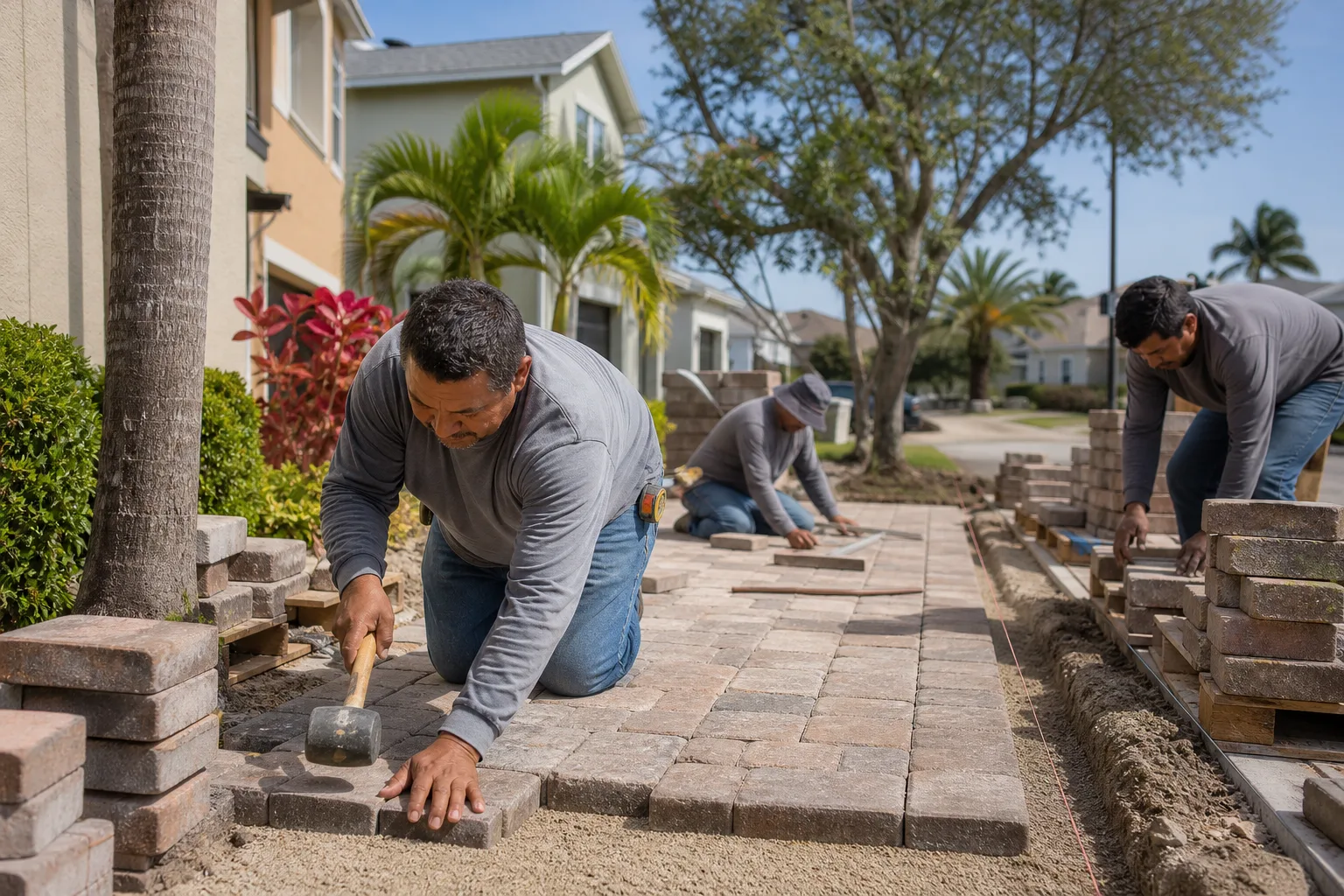
Pavers don’t wear out. They get abandoned. Four tasks, timed for Downey’s specific climate – spring inspection, late spring re-sand, fall re-sand plus sealer, and post-rain checks – are the entire difference between a 30-year driveway and a 10-year replacement. Year one is intensive; years two through ten settle into about 8 to 10 hours of homeowner effort annually. Sealer choice matters more than most homeowners realize, and the wrong product costs more to fix than the right one costs to buy. If anything on your driveway rocks, sheds water poorly, or needs base-level attention, don’t wait for next season. Call Groundwork Construction Co. of Downey at (888) 255-8179 for a free estimate – we’ll tell you what’s real, put the scope in writing, and back the work with our 730-Day Done Right Promise. Built to last, backed in writing.
Written by the team at Groundwork Construction Co. of Downey.


